
Kalamazoo City Directory Collections
Kalamazoo Public Library is the primary local shelf for city directories. KPL identifies its Kalamazoo run from 1860 and says the Kalamazoo run is complete as published, while cautioning that an edition was not necessarily issued every year. The printed books are only one layer. The Kalamazoo local-history collection also brings together maps, plats, newspapers, yearbooks, cemetery sources, clipping files, and indexes that can confirm or challenge a directory entry.
Use the Kalamazoo year as part of the evidence. The city directory tells what was printed for that edition, not what happened before or after it. A surname’s absence can mean a move, a name variant, a skipped edition, an abbreviated entry, or a listing choice. Comparing nearby Kalamazoo years and the source’s own street-order pages gives a much safer historical trail.
| Collection | Years | Where Held | Access |
|---|---|---|---|
| Kalamazoo city directories | 1860 forward; publication gaps can occur | KPL Local History Collection | Local-history room and collection-specific digital access |
| Street-order directory sections | Beginning in 1897 | KPL directory volumes | Edition-specific, primarily library research |
| Telephone directories | Earliest identified 1913; reliable run from 1949 | KPL local-history holdings | On-site access varies by volume |
| Meader Historical Directory | Late nineteenth and early twentieth century subjects | KPL scan and index pathway | Indexed scans with page-level checking |
| Post-office directory series | Almost complete series reported by KPL notes | WMU Regional History Collections | Finding aid and on-site access rules apply |
The KPL city directories collection is the source for the Kalamazoo directory run and its research guidance.
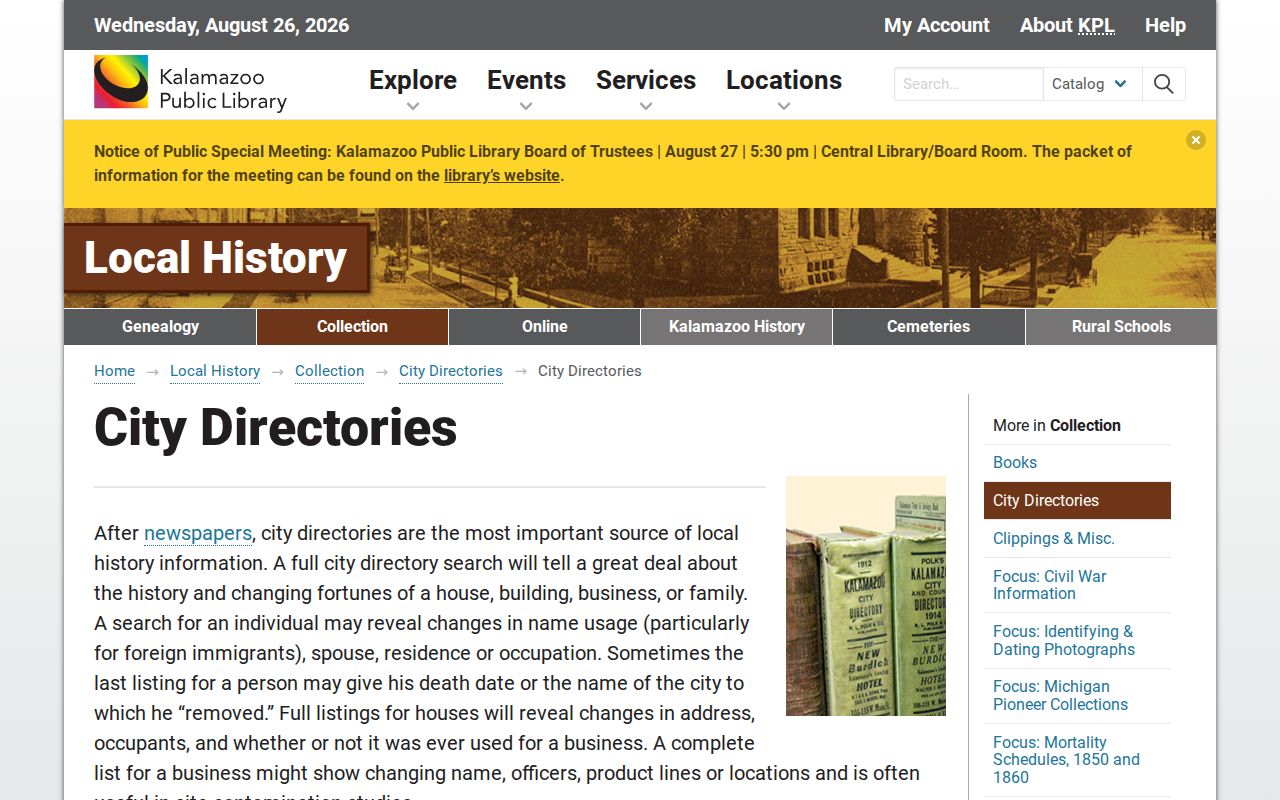
Start by noting the edition year, page, spelling, and the exact section consulted before drawing a connection across Kalamazoo records.
Kalamazoo City Directory Shelves
KPL’s Kalamazoo Local History Collection is at the Central Library, 315 S Rose Street, with the local-history room on the second floor and a 269-553-7808 contact number. Printed indexes are in the room, and nearby Tech Center reader-printers support microfilm use. The library also keeps a Kalamazoo Local Information Database for Gazette articles, magazine items, clipping files, biographies, and other local subjects. It is a practical companion when an entry supplies a name and approximate year but little context.
The Kalamazoo holdings reward a two-step approach. First locate the city-directory volume and record the entry. Then use the Kalamazoo library’s maps, newspapers, yearbooks, cemetery material, or local index to test that entry against a second dated source. KPL lists microfilm prints at $0.20 per page, although collection rules and availability should be confirmed before a visit. Staff and catalog details can also identify editions that require on-site viewing.
The KPL Local History Collection outlines the directories, maps, newspapers, yearbooks, and in-person research environment.
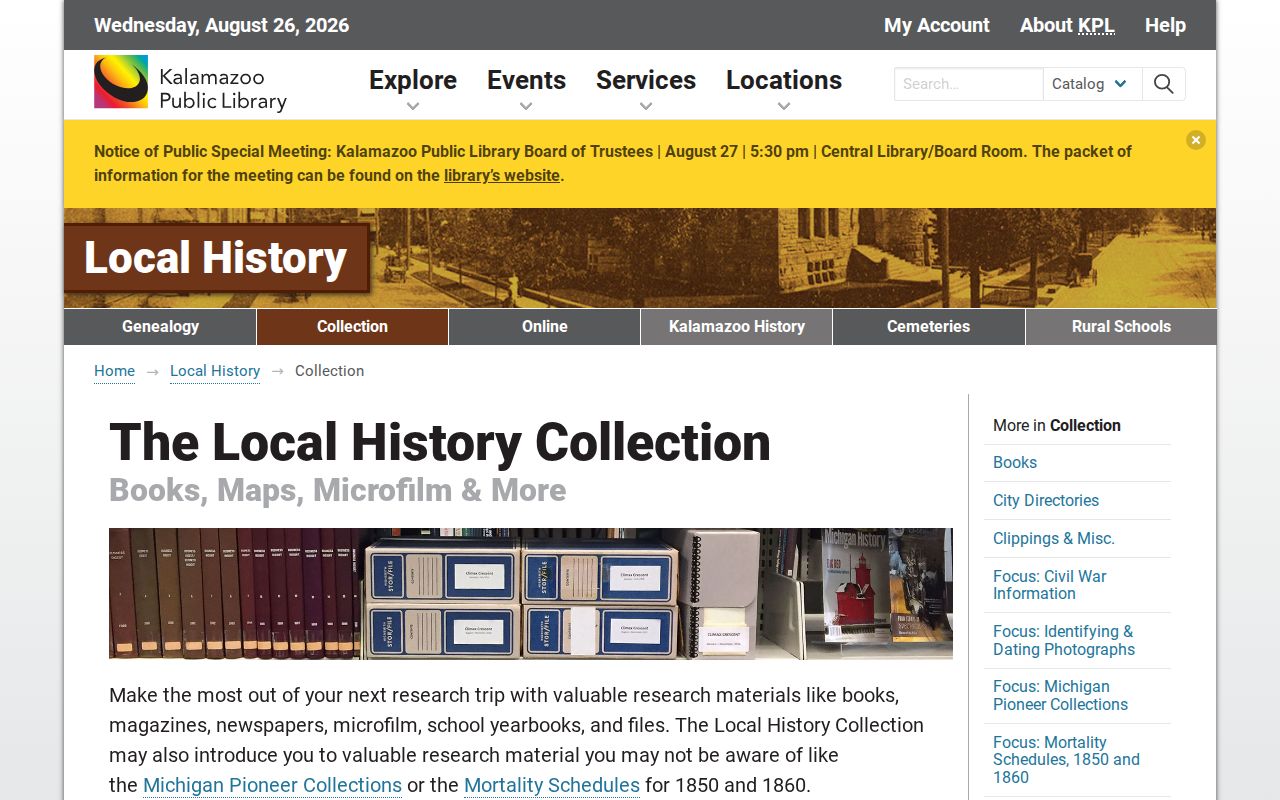
The surrounding collections help distinguish a historical directory clue from a confirmed family, property, or civic record.
Kalamazoo City Directory Scans
Digitized Kalamazoo material is useful when it preserves the scan and its citation. KPL’s Meader Historical Directory was compiled by Robert Meader, a Methodist Episcopal minister from Richland, and contains scanned biographies and photographs of hundreds of late-nineteenth- and early-twentieth-century Kalamazoo residents. The KPL name index directs users to cited scans. Record the Kalamazoo source page and keep the biography’s claims separate from later confirmation in directories, newspapers, land records, or vital sources.
KPL Local History Online also links digitized Kalamazoo books, newspapers, WMU yearbooks, and the Western Herald. Those collections expand the historical Kalamazoo city directory trail without replacing it. A yearbook or newspaper item is tied to its own date and purpose, so it should not be read as proof of a person’s current identity or address.
The KPL Meader Historical Directory demonstrates the index-to-scan route for historical Kalamazoo names.
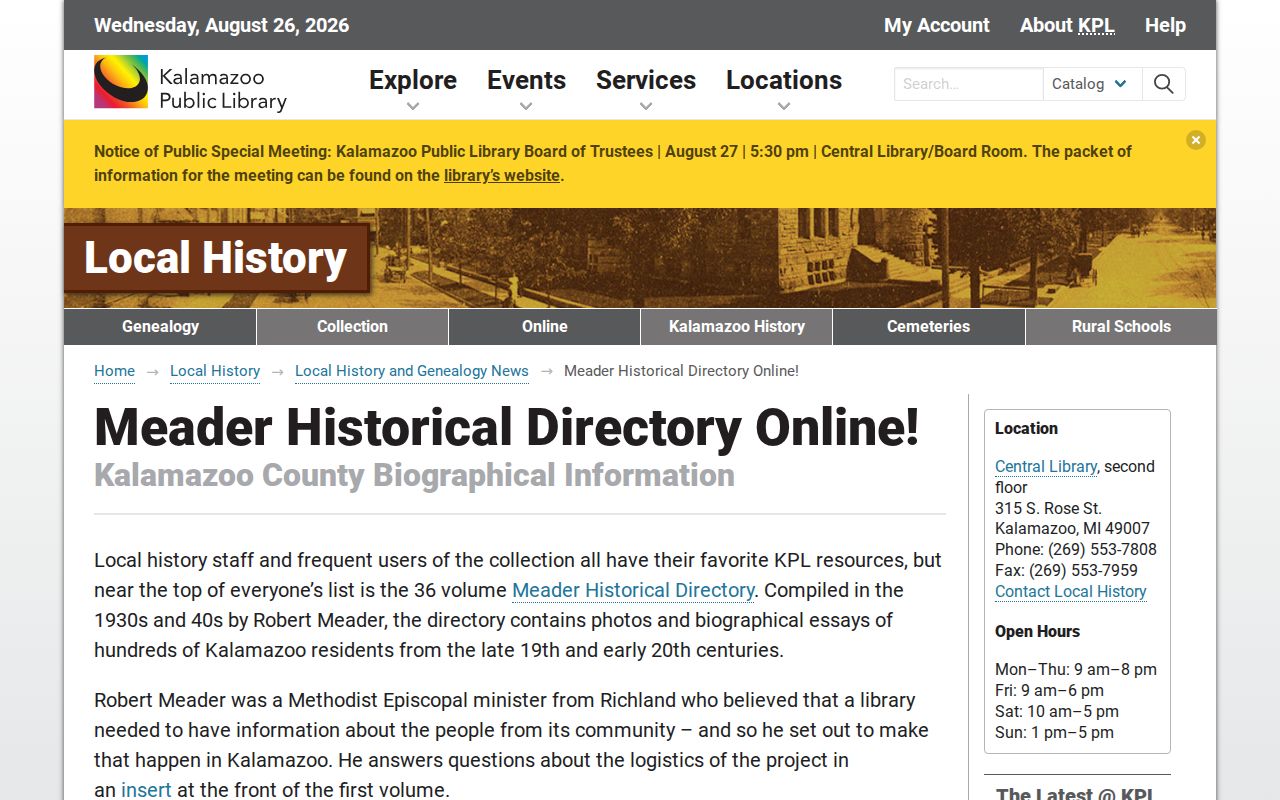
A scan, volume, and page citation preserves the source trail when a name is common or the directory used initials.
Reading Kalamazoo City Directory Entries
A typical Kalamazoo directory entry is compact, so transcribe it before interpreting it. KPL’s entry workflow identifies the name, a spouse notation in parentheses when present, occupation or profession, firm or place of activity when printed, street number and street, res, bds, same-surname and same-address clues, plus volume, year, and page. The material is historical language from a specific Kalamazoo edition. Preserve its spelling and abbreviations rather than silently modernizing them.
| Name | The listed person or household head, often using initials rather than a full given name. |
|---|---|
| Spouse notation | A parenthetical reference when printed, useful for distinguishing similar names. |
| Occupation or firm | A dated entry detail that may help separate two people with the same name. |
| Street address | The address printed for that edition, which may need a numbering or street-name check. |
| Source citation | The city-directory title, year, page, and section needed to locate the entry again. |
- Criss-cross section
- The street-order part of a later directory, which groups entries by street and address instead of surname.
- Householder index
- An alphabetical route to a listed household or named entry within a volume.
- Abbreviation key
- The front-matter guide that defines volume-specific shorthand such as res and bds.
Note: Photograph or copy the abbreviation key and title page with an entry so the edition can be checked later.
Kalamazoo Street-Order Directories
Street-order pages begin in the Kalamazoo city-directory run in 1897. They are the useful second pass after a name appears in the alphabetical section. Read the Kalamazoo name entry first, then examine the street-order page for the same year and address. That pairing may show nearby listed entries, a business use, or a changed street spelling. It still does not establish every person at the address.
For an old Kalamazoo house or block, pair the directory with KPL’s historic-house method: consult the annual Names section, follow the head or residence entry, note spouse and same-surname clues, then compare a plat and Sanborn map. The Kalamazoo street-address directory handles the current parcel and deed chain, while this historical layer helps bridge earlier printed addresses.
The KPL historic-house research guide sets out the directory, plat, and Sanborn sequence for Kalamazoo addresses.
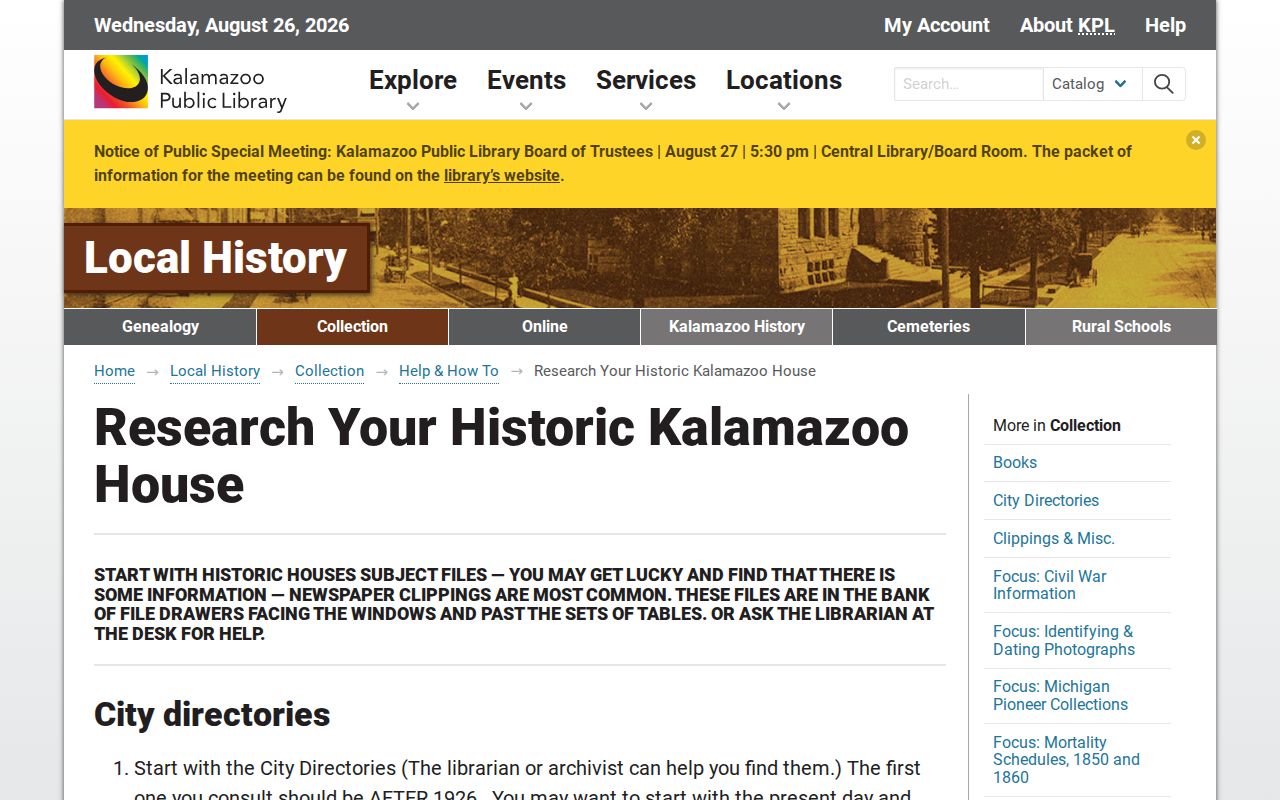
Use the map and plat layers to test address continuity, not to turn a directory listing into a present-day claim.
Kalamazoo Directory Numbering
Kalamazoo’s 1925 citywide numbering change is a major directory trap. There is no 1925 Kalamazoo directory, so compare 1924 and 1926 rather than treating the blank year as proof of a move. Before 1883, Kalamazoo numbers followed a central-point and river-distance convention near Burdick, Kalamazoo Mall, and Michigan Avenue. A 1932 Kalamazoo Sanborn map can help reconcile older and later numbers.
Street names have changed too. KPL documents Cork and St. James, Vine and Rice, Michigan and Main, Oakland and Asylum, Riverview and Seminary, plus historic Westnedge segments. Search both forms and record the volume year. The directory entry, a street-order page, a plat or Sanborn footprint, and a modern parcel are separate steps in an evidence chain, not automatic matches.
Kalamazoo Archive Companions
Kalamazoo directories become more informative beside the collections that KPL, WMU, and the state archives hold. KPL’s Kalamazoo clipping files are strongest for 1928 through 1968 and include subject and personal files, newsletters, programs, and annual reports. Its Vital Records File has abstracts of baptisms, marriages, and burials with a source-code key. The 27-volume local war-record set covers more than 10,000 Kalamazoo County people and is indexed. These are finding aids and historical sources, not certified records.
WMU Regional History Collections include Kalamazoo personal papers, organization records, local newspapers, photographs, genealogy, and Southwest Michigan history. The Kalamazoo Ward Morgan collection has approximately 27,000 negatives from 1939 through 1980. Archives of Michigan guides add early court, land, tax, military, naturalization, election, and vital series. The collection and item details are crucial, because availability can be on-site only.
The WMU Regional History Collections lists the institutional and personal materials that complement a Kalamazoo city directory search.
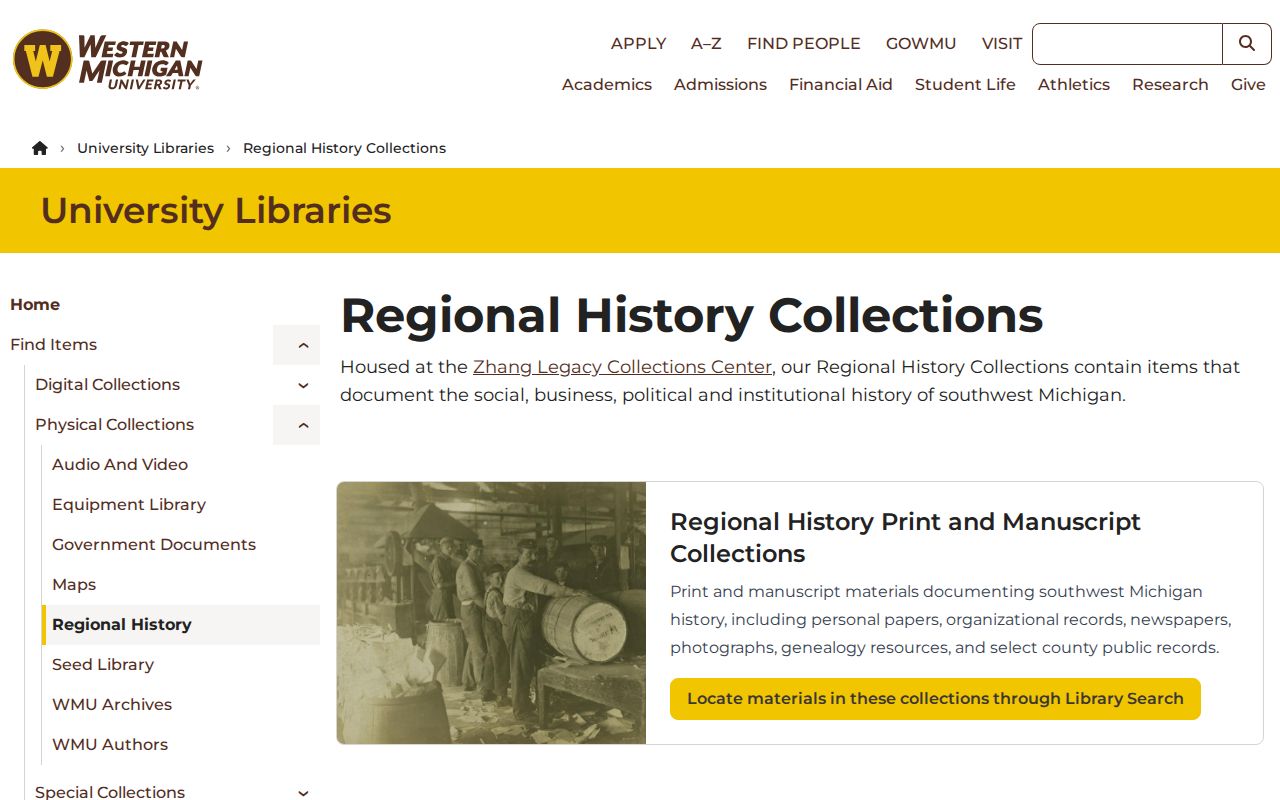
Use an archive finding aid to request a named collection, date span, or box rather than a broad name-only search.
Tracing Kalamazoo City Directory Households
Kalamazoo family-history work is most reliable when it follows a household in sequence rather than forcing a one-year entry to answer every question. Start in a Kalamazoo directory year close to a known event, then move backward and forward one edition at a time. Record spelling, initials, spouse notation, address, and page. Pair directory years with census releases, newspapers, cemetery indexes, probate indexes, or deed references that fit the same Kalamazoo period.
- Find the first likely name entry and preserve the exact Kalamazoo city-directory year and page.
- Check the entry in the next available edition, noting changes in initials, spouse notation, street, or firm.
- Use the street-order section when it exists to compare the address and nearby printed entries.
- Test an address change against the 1924 and 1926 volumes, street-name history, plats, or Sanborn maps.
- Corroborate the historical trail with a dated newspaper, vital index, cemetery record, probate index, or recorded deed.
Disappearance has several explanations. A person may have moved, died, changed a name, been omitted, or appeared under a different abbreviation. The next record should address that specific possibility rather than treating a missing entry as a conclusion.
Kalamazoo Directory Access Paths
Online Kalamazoo access begins with KPL Local History Online, the Meader index-to-scan route, the Library of Michigan catalog, and WMU finding aids. In-person Kalamazoo paths include the KPL local-history room and microfilm equipment, the WMU Zhang Center, and the Archives of Michigan or Library of Michigan in Lansing. Archive items can have access restrictions, and KPL’s microfilm print rate does not promise that every volume can be copied or downloaded.
For a difficult Kalamazoo address, ask the custodian for an edition, page, map sheet, or collection rather than asking for every record about a name. A narrow Kalamazoo request keeps the research anchored to the source. The city’s history of numbering changes and its distinct city, township, and postal areas make that precision especially important in Kalamazoo.