
Kalamazoo Previous Resident Sources
The best source changes with the period. Modern parcel and deed records help establish the land trail. Kalamazoo Public Library street-order directories are the historical address-to-occupant layer, and its house-history material joins directories with plats and Sanborn maps. Probate, obituary, newspaper, cemetery, and vital sources can add dates and relationships when an owner or household disappears from the next edition. Mark each transition as a documented fact or an inference, because none of these sources alone lists every person who lived in a house.
| Source and era | Years it covers | Where held | What it shows |
|---|---|---|---|
| Register of Deeds index and images | 1831 forward, with index completeness varying | Kalamazoo County Document Searches | Recorded grantor, grantee, instrument, and document data |
| FamilySearch deed films | Records 1831-1901; index 1831-1903 | FamilySearch catalog | Older deed books and index reels, subject to access terms |
| Kalamazoo city directories | From 1860; street order from 1897 | Kalamazoo Public Library | Dated names, addresses, occupations, and street-order entries |
| Telephone and map sources | Telephone books from 1913, reliably complete from 1949; selected map years | KPL local history and Library of Congress | Address continuity, structures, and neighborhood context |
| Probate, notice, and vital sources | Collection and access period vary | Probate, County Clerk, KPL, and Archives | Estate, death, relationship, or publication clues |
Start with the era you can document. A property transfer begins at the Register. A mid-century household usually begins with a directory edition and then a street-order entry. An older site may require a plat, legal description, or Sanborn sheet before its historic address can be connected to a modern parcel. The aim is a dated sequence, not a guess based on a current owner field.
Kalamazoo Addresses Before 1925
Kalamazoo's citywide renumbering in 1925 is a major break in a previous-residents search. Kalamazoo Public Library reports no 1925 directory, so compare the 1924 and 1926 editions rather than assuming the same house number continues across the gap. Earlier, pre-1883 numbering used distance from a central point near Burdick, Kalamazoo Mall, and Michigan Avenue. An old number is a historical locator until it is matched with a street name, map, and directory entry.
Street names also changed. KPL documents Cork and St. James, Main east of the river and East Avenue, Michigan and Main, Oakland and Asylum, Riverview and Seminary, Vine and Rice, plus historic changes to Westnedge segments. Search both forms before declaring a trail ended. The county Street Name Directory's range and odd-even parity can serve as a checksum, but the historic layout needs to be reconciled before it is treated as a modern address.
KPL's Kalamazoo street-name history is the source for the local changes and numbering context used in this previous residents search.
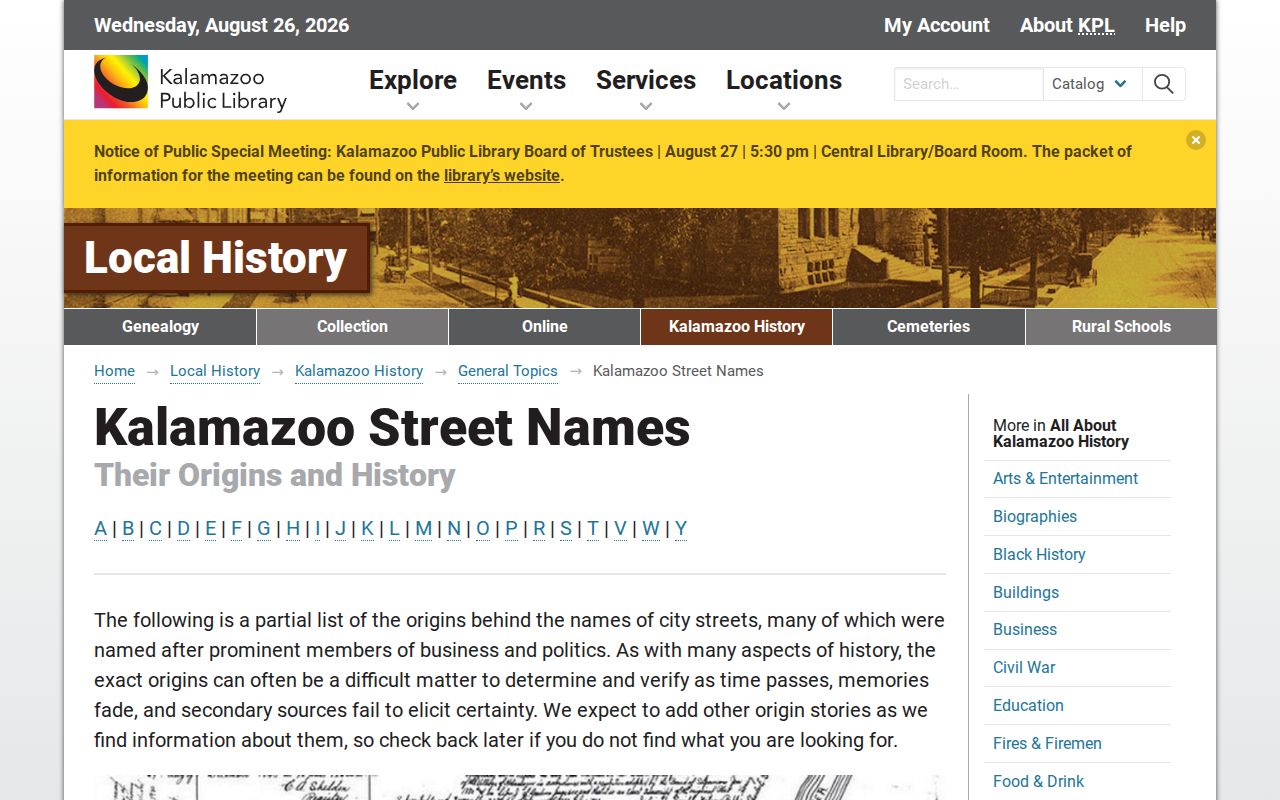
The street-history page helps bridge an older directory or newspaper address to the street name used in later records.
Note: A matching house number is not enough after a renumbering or street change; confirm it with dated map, directory, and parcel evidence.
Kalamazoo Deed Chain for Past Residents
Deeds trace land interests, not a guaranteed list of occupants. Start with the county parcel search or City BS&A property record to capture the present parcel ID, current owner, and legal description if displayed. Use the current owner as a grantee in the Register index to locate a purchase document, then move to the seller as the earlier grantee. Retain the instrument type, recording date, document number or liber and page, parcel or legal-description reference, and image status at each link.
- Locate the current parcel by address and write down its parcel ID, legal description, and owner field.
- Search the owner, parcel number, document number, date range, or liber and page in the County Document Searches index.
- Open the relevant recorded instrument through the available image or copy route and identify the prior party, date, and property reference.
- Search that earlier party as grantee, then repeat backward while comparing the legal description and dates.
- For a break in the online path, use the public workstation, targeted staff lookup, FamilySearch film, or the Register office. Staff do not provide an in-depth title search.
- Grantor and grantee
- The grantor transfers an interest in the recorded instrument. The grantee receives that interest.
- Chain of title
- A dated sequence of recorded land transfers tied to the same property. It is not a legal title opinion.
- Legal description
- The lot, block, plat, or other land description used in the document. It is often more reliable than a historic street address.
The Register's free search supports name, date range, liber and page, document number, and parcel number. Images and copies use the county's paid routes, while the public workstation offers free searching and paid prints. A prior owner in a deed is a land-record fact. It becomes a household lead only after another dated source supports it.
Kalamazoo Directories and Census Trails
To find who lived here before rather than only who owned the land, pair a directory with household evidence from the same era. Kalamazoo city directories begin in 1860, and street-order sections begin in 1897. A street-order entry places a name or business at an address for that edition. The alphabetical entry can add occupation, spouse notation, street number, and abbreviations such as res or bds. Keep the volume, year, and page with every transcription.
Federal census material follows the 72-year release rule. It should be used as a period check, not as an automatic address match, because street names, enumeration practices, and available indexing differ. Pair the nearest available census with directory editions on either side. Newspapers, school catalogues, yearbooks, and the KPL Local Information Database can then explain a move, death, organization role, or other change in the dated trail.
The historical volumes themselves are described on the Kalamazoo city directory collections page. Here, use them as one link in the address sequence rather than treating an entry as a current profile.
Household flow: directory year and street order, then the nearest released census, then a newspaper or vital clue, then the next directory edition. If the address or name changes, return to the street history and map evidence before continuing.
Kalamazoo Maps for Previous Residents
Maps bridge an address to its physical site. KPL's house-history guidance uses directories, the “Names” and street-order sections, plats, Sanborn maps, and historic-number reconciliation together. Plats and atlases can show lots, blocks, structures, or ownership labels that do not match a modern address. Sanborn material helps compare a building footprint and land use, but it does not prove a resident's identity.
KPL identifies local Sanborn years including 1887, 1891, 1896, 1902, 1908, 1932 republished in 1958, and bound 1957 material. The 1932 set is particularly useful for old and new numbering context after the 1925 change. A sensible evidence chain is historic directory entry, street-order entry, plat or map, Sanborn footprint, then current parcel or GIS. Label the interpretation where a source does not state the connection directly.
Kalamazoo Previous Residents in Notices
Newspapers, obituaries, cemetery records, and probate provide the end points that a deed chain cannot. KPL describes near-complete Kalamazoo Gazette coverage from the nineteenth century to the present, while the Library of Michigan county guide lists Gazette holdings from 1837 through 2018. The local-history room's Local Information Database indexes Gazette articles, clipping files, biographies, and local subjects. Its clipping files are especially useful for 1928 through 1968, although a clipping is still a dated source rather than a complete life record.
Probate's public index begins in 1832 and includes public cases in real time, with no document images online. Older material is on microfilm or in files according to the court's coverage notes. Search an estate by surname, record the case type, status, file date, fiduciary, and docket detail, and request permitted pages from the court. A death notice, estate index, and recorded deed can corroborate a transition, but none should be expanded into facts the underlying document does not state.
Kalamazoo Archives Beyond a Deed
When the index is silent, do not force a conclusion. The KPL Kalamazoo genealogy sources point to deeds, atlases, cemetery, newspaper, clipping, vital, military, and Meader resources. The Archives of Michigan county guide lists historical deed, tax, court, naturalization, election, and vital series with separate date ranges. Western Michigan University Regional History Collections add personal papers, organizational records, newspapers, photographs, and genealogy research that can supply community context.
KPL's genealogy-source guide is shown here because it gathers local routes for historical Kalamazoo previous residents research.
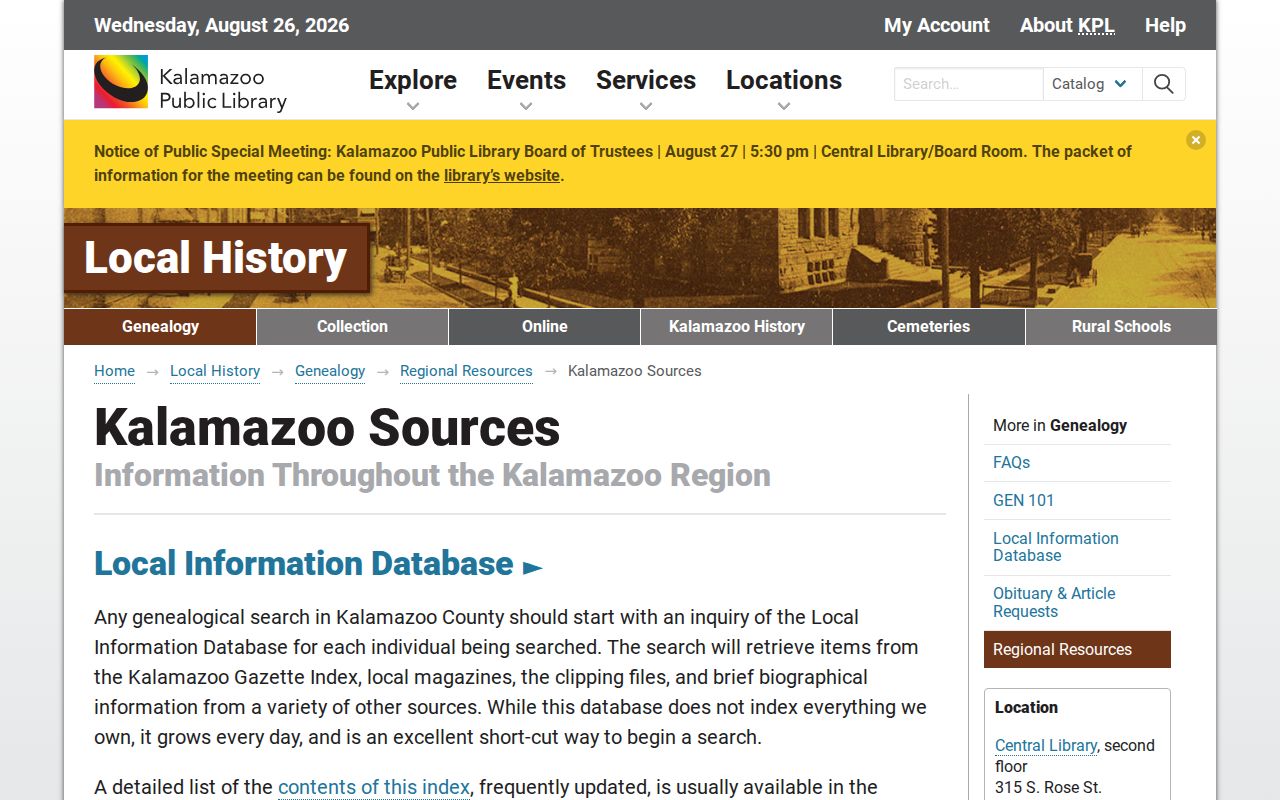
Use the listed collection route to ask for a named person, address, record series, or date span instead of an open-ended request.
Online no-hits can reflect a search-field gap, spelling variant, boundary change, or catalog limitation. KPL, WMU, the Register, and the Archives each offer a different fallback channel.
Kalamazoo Previous Residents and Privacy
Address research has clear limits. Parcel ownership, a recorded deed, a map, or a directory entry does not establish every member of a household. Utility customers, non-owner occupants, protected voters, and confidential-address participants should not be inferred or published. Michigan's Address Confidentiality Program provides a designated address and mail forwarding for qualifying people facing safety risks. Do not combine public clues to defeat that protection.
Historical research is strongest when it stays within its purpose: house history, family history, estate research, or local history. Keep only the fields needed to identify the source and date. For an error in a deed, court file, vital record, or archive description, contact the original custodian rather than attempting to correct it through a directory entry.
Lawful use. Research on Kalamazoo previous residents should remain personal, historical, and careful. Public records do not permit stalking, harassment, unwanted contact, or the exposure of protected location information.